"What we're trying to find is a business that, for one reason or another -- it can be because it's the low-cost producer in some area, it can be because it has a natural franchise because of surface capabilities, it could be because of its position in the consumers' mind, it can be because of a technological advantage, or any kind of reason at all, that it has this moat around it." -Warren Buffett
When evaluating established businesses it is important to understand several aspects of the business including:
1. Can the business generate high returns on capital vs. the cost of its debt and equity funding?
2. Does the business have opportunities in its runway to reinvest the cash it throws off at increasing returns on capital.
3. Is the business run by a solid management team that are adept at capital allocation.
4. Does management have any skin in the game (own rather large stakes in the business)?
King of the Castle
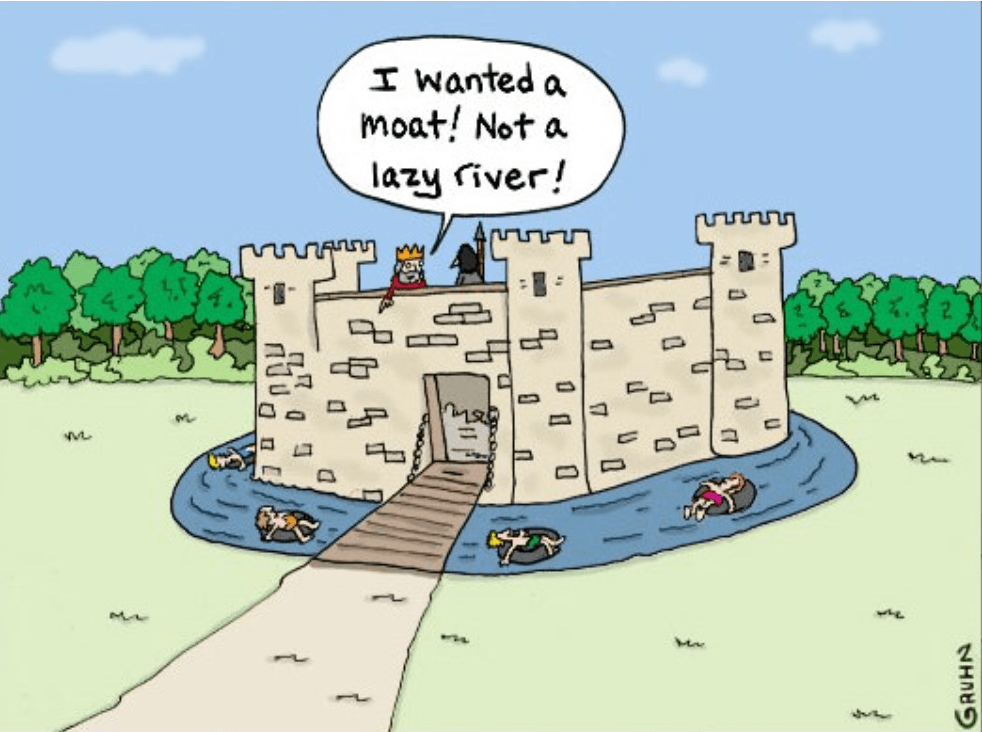
Central to these questions is the idea of competitive advantages or a moat. Just as a moat is a needed tool in the arsenal of a King's castle so is the importance of competitive advantages to drive business success.
Companies that have high returns on invested capital invite competition. What company doesn't want to earn a higher return on their investments? If you know one, they will most likely not be in business much longer.
 When analyzing companies it is important to understand if they have sustainable competitive advantages to fend off their peers in the market and upstarts that look to disrupt its business.
The three main modes that firms compete on to a large extent are cost, differentiation or niche focus.
The concept developed by Michael Porter is seminal to understanding what strategies are used to compete in the specific industries companies operate in.
The ways in which cost, differentiation and focus manifest themselves come in the form of Network Effects, Brands, Intellectual Property, Efficient Scale and Switching Cost.
Network Effects:
A network effect occurs when a product or service becomes more valuable to its users as more people use it. Most successful internet companies are predicated on developing demand side economies of scale through the use of network effects.
Many people seem to understand linearity and growth of value increasing over time but the power of network effects is evident in its exponential nature of value creation.

 For example, take the peer to peer social network of Facebook (FB), the company's revenue and MAU's tracks to Metcalfe's Law that states that the value of a network is proportional to the square of the number of connected users. Even if the amount of users grows linearly, the value is exponential. Which is depicted by the chart to the right that maps out FB's revenue and MAU's.
Brand:
It is a self evident notion that brands are everywhere and inform consumer behavior. Companies that develop superior brands have a major business advantage as they are better able to draw customers in, and maintain pricing power.

Starbucks is perfect example of a brand that has been able to grow its reputation for high quality coffee since 1971. Starbucks has been able to maintain a higher priced cup of coffee than its competitors and customers are still willing to pay more for the everyday luxury of a Starbucks cup of coffee.
In a consumer business where people are inundated everyday by choice, companies with strong brands are able to gain new customers, increase prices, customer lifetime value and market share at the detriment of weaker brands.
Intellectual Property:
Companies that have a proprietary secret sauce that other competitors cannot replicate without legal ramifications is very powerful, as it allows the company to be the only game in town with the most powerful weapon.
Types of intellectual property include patents, trademarks, copyrights and trade secrets.
This level of protection is essential in some industries such as Pharmaceuticals.
For example, patents protect the excess returns of pharmaceutical manufacturers such as Novartis (NVS). When patents expire, generic competition can quickly push the prices of drugs down 80% or more.
Efficient Economies of Scale:
Companies that develop efficient economies of scale are able to leverage their size to get better deals on sourcing products, learn about their customers, make better decisions over time and leverage their fixed cost base to produce better margins.
 A company benefiting from efficient economies of scale puts itself in a position to increase its gross margins and its bottom line as it grows. An example of a company benefiting from economies of scale is Costco (COST).
Costco customers sign up for a membership that is ($60-$120) a year for the ability to buy items in bulk at a reasonable price. Costco members find value in buying the bulk items as they are able to get better deals than they would get at other supermarkets and the proof is in the pudding as of Q2 2020 renewal rates of membership are at 90.9% in U.S. and Canada. for Costco is then, in turn, able to have greater buying power and upfront working capital to be able to make large bulk purchases on merchandise for their warehouses. Costco is also using data from their operations to inform better decisions and reduce costs.
Costco has found ways to reduce waste by utilizing smart inventory practices (developing a demand forecasting algorithm that helps store managers keep the right amount of goods on the shelves). Costco’s limited product selection helps to further reduce excess inventory and unsold goods, and the company's controls, especially, with a Costco employee marking customers receipt at the door leads to less theft than other supermarket or retail stores.
Costco's ability to use its buying power advantage and its ability to efficiently use data to inform their business processes has allowed it to maintain a highly competitive position in a very competitive market.
Switching Costs:
Switching costs are inconveniences and or expenses a customer incurs in order to switch over from one product to another, which make a company's revenue stickier than its peers.
Companies that make it tough for customers to switch to a competitor are in a position to increase prices year after year to deliver hefty profits. Companies aim to create high switching costs in order to "lock in" customers. The more customers are locked in, the more likely a company can pass along added costs to them without risking customer loss to a competitor.
 For example, Autodesk (ADSK) is the industry standard for computer-aided design software for millions of industry professionals. 70% of Autodesk's business is in architecture, engineering, and construction. Autodesk has created a competitive advantage for itself in the way that it has embedded itself in the daily technical use of engineering professionals. Since it is so ingrained in the daily work of millions of people, it has developed a switching cost advantage. Employers would rather renew their subscription to Autodesk than go to a cheaper product due to the costs and barriers to retraining teams to use the new software.
The power of the switching cost for Autodesk starts in its approach to target universities and informing engineering curriculum. Engineers are trained to design and build using AutoCAD software. To understand the power of this over time. Based on data from educationdata.org, 121,956 engineers graduated in the US in 2018 alone. As a part of the engineering curriculum that is taught, a high percentage of those students learned how to use AutoCAD software in their classes. Those engineers go out into the working world already trained on the product. After several years of doing this Autodesk has reached over 100M people that use their software.
Conclusion:
Competitive advantages allow businesses to attract and maintain new customers, grow margins and return on invested capital over time.
However, just because a company in the past has proven to have competitive advantages currently reflected in high returns on invested capital it does not mean that the competitive advantage is durable or would sustain in future.
By maintaining durable competitive advantages and having exceptional opportunities to invest in is what creates lasting economic value and builds companies into compounding machines.

